Russian captivity
War and PeaceRussian captivity is presented as one of the most extreme consequences of the French invasion of Russia: Russian prisoners are detached from civilian life, stripped of meaningful names and histories, and absorbed into a system that treats bodies as numbered objects, burdens, and expendable lives. Pierre Bezukhov’s experience gives this condition its fullest psychological and philosophical expression, moving from arrest and interrogation through execution, reprieve, forced marching, deprivation, and the recognition of an apparently impersonal force governing both captors and captives.
Origins in War and Occupation
Russian captivity arises within the general catastrophe that begins on June 12, 1812, when the forces of Western Europe cross the Russian frontier. The narrative rejects the notion that such a war can be explained by a single diplomatic decision or by the will of one ruler. Millions are drawn into a process that produces crimes, thefts, false accusations, incendiarism, and murder on a scale that overwhelms ordinary legal categories. Captivity is therefore not an isolated misfortune but one expression of a war whose participants are driven into actions they do not experience as ordinary crimes.
The occupation of Moscow intensifies this collapse of civic order. The French enter the city tattered, hungry, exhausted, and reduced to a third of their original number, yet still marching in military formation. Once dispersed into deserted houses, however, they cease to function as an army and become marauders. Their objective changes from conquest to the possession of whatever they have taken, while the city itself becomes neither a functioning community nor a stable military camp. In this environment, Russians suspected of resistance, espionage, or incendiarism can be seized and processed outside the protections of ordinary civil life.
The same exception appears in the treatment of Vereshchagin, whom Count Fyodor Rostopchin publicly identifies as the man responsible for Moscow’s ruin and hands over to the crowd. Vereshchagin stands in chains on the steps, his thin hands folded and his half-shaven head lowered, while official accusation and popular pressure converge upon him. His treatment establishes the larger logic of captivity: a person is first renamed as a traitor or enemy, then exposed to violence that no individual participant fully claims as his own.
Arrest, Classification, and Interrogation
Pierre is arrested after the violence of the occupation and initially receives a contradictory treatment. The officers and soldiers who seize him are hostile but also respectful, uncertain whether the large man in the peasant coat might be someone important. That uncertainty disappears when the guard changes. The new guard no longer recognizes the person who fought desperately with a marauder and convoy or spoke of saving a child; they see only prisoner number 17, detained by order of the Higher Command. Captivity converts a singular biography into an administrative label.
Pierre is placed with prisoners from the lowest social class, who avoid him because he is a gentleman and speaks French. His language, which elsewhere marks education and social position, becomes an additional sign of difference inside the prison. He is then questioned by a French general with a white mustache, two colonels, and other officers. The interrogation asks who he is, where he has been, and what he intended, but the questions are structured less to discover truth than to direct his answers toward conviction. The process resembles a channel through which only officially acceptable answers may flow; anything that does not fit the desired result is discarded.
This procedure reveals captivity as a legal-looking form of power whose outcome has already been prepared. Pierre cannot understand why the questions are being asked because the inquiry does not genuinely seek the essence of his actions. His uncertainty is not simply personal confusion: it is the condition produced when an institution claims to judge a person while refusing to recognize the person’s actual motives, memories, and circumstances.
Execution, Reprieve, and the Collapse of Meaning
The prisoners are taken from Prince Shcherbatov’s house across the Virgin’s Field to a kitchen garden, where a post and a freshly dug pit await them. French troops in blue uniforms with red epaulets and high boots form lines on either side, while Germans, Italians, Frenchmen, and a few Russians gather as spectators. The prisoners are arranged according to a list, and Pierre is sixth. This ordering makes the approaching violence appear methodical and impersonal, as though a list could transform killing into a routine administrative act.
When the drums begin, Pierre feels that part of his soul has been torn away. He loses the power to think or understand and can only hear and see. The scene is not narrated as a clear contest between deliberate villains and innocent victims. Instead, it exposes a machinery in which people occupy assigned positions and carry out actions whose moral meaning they cannot bear to face. After the executions, a French soldier says that the lesson will teach the prisoners not to start fires, but his attempt to justify what has happened collapses before he finishes. The crowd disperses silently, with lowered heads, and even the participants seem unable to absorb the deed as their own.
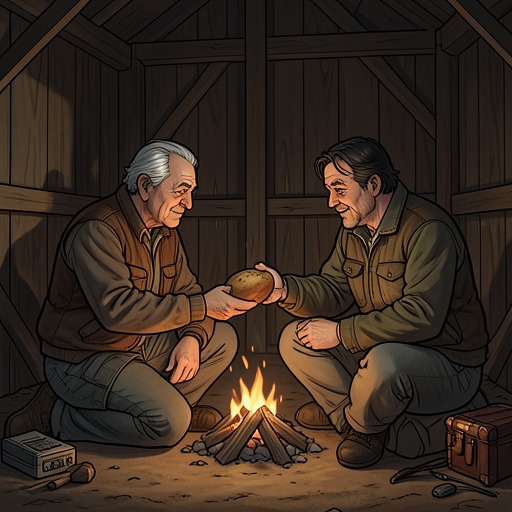
Pierre is unexpectedly pardoned after the execution and placed alone in a small, ruined, filthy church before being transferred to a prisoners’ barracks. The reprieve does not restore him to ordinary life. Among roughly twenty men in a shed made from charred planks, beams, and battens, he hears voices and answers questions without understanding their significance. The murders have severed the inner mechanism that once made the world appear ordered and alive. His faith in humanity, the universe, and his own soul is shaken because the violence was committed by people who did not seem to wish to commit it.
The Impersonal Force of Captivity
During the prisoners’ removal from Moscow, Pierre begins to recognize a force that is neither identical with a single officer nor reducible to a personal intention. A corporal who had previously seemed familiar arrives in marching kit with soldiers, knapsack, and shako; the uniform alters his face and makes him appear like a stranger. When Pierre asks what will happen to a sick prisoner, the corporal shuts the door after a rattle of drums and meaningless oaths. The drums drown the sick man’s groans, and Pierre recognizes again the callous power that compels people to kill against their will.
This recognition changes Pierre’s behavior. Entreaties and exhortations now seem useless because the men before him are serving as instruments of a system larger than their individual wishes. He understands that resistance to this force may be impossible and that survival requires waiting and enduring. Captivity thus produces not only physical confinement but a new theory of human action: responsibility becomes dispersed among orders, uniforms, classifications, fear, and collective momentum.
The march itself makes that theory visible. Prisoners and guards move along the Kaluga road amid carts, soldiers, women, ammunition, and baggage, all driven forward by the same pressure to get on quickly. Individuals become difficult to distinguish; what Pierre perceives is movement. When the column halts at dusk, the apparent purpose of the march dissolves into anger, quarrels, blows, and confusion. A carriage damages a cart, soldiers beat the horses, men fight among themselves, and a German is wounded in the head by a sword. The halt exposes the hidden uncertainty beneath the column’s momentum: no one seems to know where the journey is leading, only that painful and difficult conditions await.
Hunger, Discipline, and the Prisoner’s Body
The material conditions of captivity are severe. At the first halt, the prisoners receive horseflesh as their meat ration. Their treatment worsens when the guards discover that a Russian soldier has escaped by pretending to suffer from colic. A French soldier is beaten for straying too far from the road, while an officer threatens a noncommissioned officer with court-martial and declares that those who lag behind are to be shot. Military discipline therefore operates directly upon the prisoner’s body and indirectly upon the bodies of the guards themselves, who are punished or threatened whenever the system loses control of its human cargo.
Pierre’s own body records this condition. He is girt with a rope and wears shoes made by Platon Karataev from leather torn by a French soldier from a tea chest. The shoes are a small but exact sign of captivity’s economy: discarded military material is converted into protection for a prisoner’s feet, while ordinary acts of repair persist inside a world organized by coercion. Pierre tries to help the sick Sokolov by suggesting that a hospital may remain behind, but the renewed drums and the closing of the shed prevent him from changing the man’s fate.
The guards’ changing behavior also demonstrates how quickly personal relations are subordinated to institutional roles. The corporal who had once offered Pierre a pipe appears transformed by marching equipment and orders. The captain whom the corporal had described as willing to help him likewise becomes part of the cold authority governing the column. Familiarity cannot survive the command structure for long; uniform and duty reclassify the individual and make compassion structurally fragile.
Narrative and Thematic Significance
Russian captivity extends the novel’s broader contrast between the language of official power and the physical reality of war. At the men’s table, the declaration of war is explained through a formal manifesto that speaks of Russia’s safety, dignity, alliances, and the establishment of peace. In captivity, those abstractions become numbered prisoners, interrogation formulas, drums, ropes, hunger, forced marches, and orders to shoot those who fall behind. The distance between political explanation and bodily consequence is the measure of the system’s violence.
The condition also echoes the novel’s treatment of military discipline before battle. Russian soldiers near the enemy can be seen preparing shelters, drying clothes, mending boots, waiting for porridge, and drinking vodka with calm faces, even though many will soon be left on the field. Yet beside these peaceful routines, a naked soldier is beaten for theft. The army’s order contains care, habit, punishment, and coercion at once. Captivity removes the remaining protections of belonging and makes the disciplinary side of war dominant.
Through Pierre, the narrative defamiliarizes violence that might otherwise become familiar as a conventional episode of wartime suffering. The sequence slows over lists, uniforms, drums, faces, clothing, food, carts, and bodily gestures, forcing the reader to perceive how ordinary objects become instruments of classification or survival. A prisoner is not only locked up; he is numbered, questioned, arranged, marched, fed what the army can spare, and threatened with disappearance if he cannot keep pace.
The decisive significance of Russian captivity is therefore philosophical as well as historical. It reveals how war creates a state in which legal identity can be suspended while authority becomes more immediate, not less. Pierre’s imprisonment shows that the most terrifying power is often not a single tyrant’s conscious decision but a concurrence of orders, fears, habits, and circumstances that makes violence appear inevitable. At the same time, the surviving traces of human action—Pierre’s concern for Sokolov, Karataev’s handmade shoes, and the soldiers’ momentary shame after the executions—keep the prisoners from becoming mere symbols. Captivity destroys the ordinary ordering of life, but the narrative continues to search within that destruction for the fragile persistence of human recognition.